

The open-source AI software factory for agencies
Run your agency
like a software factory.
Every client brief becomes specs, a roadmap and pull requests your team reviews, held to one standard. Open source, on your own model keys.
How it runs
Three loops, running for every client at once.
- 01Context loopListens
- Client briefs and calls
- Linked Teams meeting transcripts
- Repo and tracker sync
Every transcript, document and decision stays with the project, so each new feature starts from all of it.
In Fabric Context and Meeting Digest
- 02Delivery loopBuilds
- Agents draft PRD, spec and architecture
- You press Start work
- A coding agent opens the pull request
Your engineers review and merge.
In Fabric Roadmap and the feature page
- 03Feedback loopReports back
- Daily Brief
- Release notes, reviewed then published
- Decisions log
The client is up to date without a status meeting, and their next call flows back into context.
In Fabric Daily Brief, Release Notes and Decisions
Built by TechFabric, whose engineers have delivered software for


Works with the tools your team already uses
- GitHub
- Jira
- Notion
- Slack
- Confluence
- GitLab
- Teams
Plus Azure DevOps, Gmail, Google Drive, and anything with an MCP server.
Who runs it
Run every client project on one line.
For your clients
Hold every client to the same standard.
Delivery quality should not depend on which senior engineer a client got. Fabric puts your way of working on the line, and each client's work in its own project.
- A project per client
- Its own documents, repositories and coding instructions, so an agent starts from that client's context.
- Their tracker, not yours
- Link each project to the client's Jira, Azure DevOps or GitLab. The backlog syncs both ways.
- Clients see their own work
- Invite a client into one project as a viewer or commenter. They see that project and no other.
- Decisions kept per client
- Each feature keeps the decisions behind it, so whoever picks up the client next can see why it was built that way.
For your delivery team
Keep the reasons with the work.
Your engineers already use coding agents. What those agents lack is the client's decision behind the ticket, a memory that outlasts the session, and a record of what was done.
- Works from your tools
- Use Fabric from Claude Code, Cursor or VS Code over MCP, the CLI or the API.
- A record that stays
- Documents, features, decisions and pull requests in one place, kept between sessions and cited.
- Each client's standards
- A project's coding instructions travel with every run, so an agent builds the way that client's codebase expects.
- The client's environment if they need it
- Run Fabric yourself with Docker Compose or Aspire, on your own model keys.
Three loops
Put every client on the same three loops.
In Fabric, agents run the loops and you set the boundaries. Nothing is coded until someone presses Start work, and every change arrives as a pull request your team reviews and merges.
Loop sheet · Every client project
| Number | Loop | Runs on its own | Where your people sit | What comes out |
|---|---|---|---|---|
| 01 | Context | Briefs, call notes and the repository go into the client's project. Linked Teams meetings sync their transcripts, and work items sync with the client's Jira, Azure DevOps or GitLab. | Decide what the project reads. | Context the agents cite |
| 02 | Delivery | Agents draft the PRD, technical specification and architecture. Once someone presses Start work on a feature, a coding agent writes it on a branch and opens a pull request. | Shape the roadmap, press Start work, review and merge. | A pull request on the client's repository |
| 03 | Feedback | Fabric drafts the release notes and keeps the decisions log, and writes the Daily Brief from the project's activity when someone asks for it. | Ask for the brief, and review the release notes before they publish. | An update the client can read |
The floor view
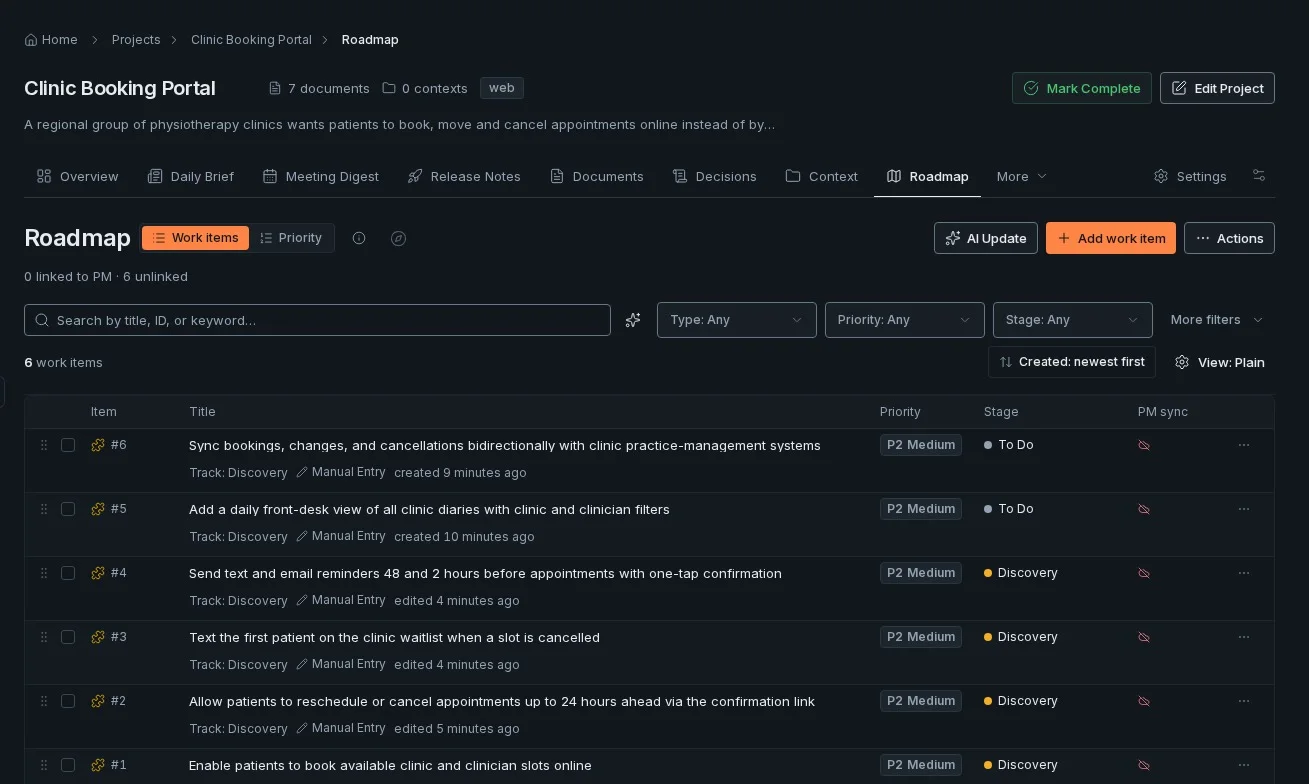
See where every feature stands.
Each client's roadmap shows every feature with its priority and its stage, so the state of the work needs no status meeting.
The gate
People decide what gets built and what merges.
Agents draft the documents. A person reviews them, shapes the roadmap, marks a feature's requirements complete and starts work on it. The coding agent opens a pull request on GitHub, and your team reviews and merges it there, under the branch rules you already have.
- Start work
- A feature is coded only after a person starts work on it.
- Pull requests
- A coding run ends in a pull request on the client's repository, reviewed and merged by your people.
- An audit log
- Administrative actions, sign-ins and lifecycle changes, filterable by actor, project and outcome.
The record
Every answer shows where it came from.
Ask a question about a client's project and the answer arrives with the passages behind it: the ticket, the document, the pull request. Checking it means reading the source, not trusting the summary. Ask why something was decided a year later and get a real answer.
Everything that made a project go well lived in a few people's heads. Writing it down felt slow at the time. It was the only thing that ever actually scaled.
Proven on our own floor
Watch a software company run its own client work on it.
Ten people to three
Delivery headcount, at TechFabric
TechFabric is a software development company. It built Fabric because its delivery did not scale, and it runs that delivery on Fabric today. Work that took ten people now takes three.
We were in every project. That was the promise we had made to clients, and for a long time it was the only way we knew how to keep it.
I looked after the accounts we could least afford to get wrong, so I was the escalation path for all of them at once. That holds up until two of them need you in the same week.
Pricing
Free. Your keys, your models.
There is no paid tier to upgrade to. You bring your own AI provider keys and pay the provider directly, with no markup. The hosted service is the same product as the open-source release.
Apache-2.0
License
BYO keys
Model providers
Self-host
Docker or Aspire
- Cloud01
Start free in the cloud.
Sign up, add a model key from any of twenty providers, connect a client's repo. - Self-hosted02
Run it in your own environment.
Run Fabric in your own or your client's environment with Docker Compose or Aspire, so the client's data stays on infrastructure you control. - From your editor03
Use it from the tool you have open.
Point Claude Code, Cursor or VS Code at Fabric and use its context, agents and integrations from the tool you already have open.
FAQ
Questions
What is Fabric?
Fabric is an open-source AI software factory for software agencies. Each client gets a project with its own repositories, documents and coding instructions. Agents draft the requirements, specification and architecture, and a coding agent works a feature a person has started into a pull request. It is built by TechFabric and licensed Apache-2.0.
Can a software agency use Fabric for client work?
Yes. TechFabric, a software development company, runs its own client delivery on Fabric. Each client gets a project with its own documents, repositories, coding instructions and tracker link, so agents work from that client's context. You can invite the client into their project as a viewer or commenter, and your people review and merge every pull request.
How does Fabric keep client work separate?
A client you invite to a project sees that project and no other. Project access is checked on every read, and an organization is a separate tenant, isolated with row-level security in Postgres. An agency that wants a harder line can run one organization per client, or self-host Fabric in the client's own environment.
How is Fabric different from Glean, Onyx or Dust?
All four answer questions from company knowledge. Glean is a hosted enterprise platform sold through a demo, and Dust is hosted, with single-tenant deployment for enterprises. Onyx is open source and self-hostable, centred on search and chat. Fabric is Apache-2.0 and self-hostable too, and it adds the delivery loop: documents, a roadmap of features, and coding runs that end in a pull request your team reviews.
How does a client brief become a pull request in Fabric?
The brief, call notes and repository go into the client's project as context. Agents draft the business case, PRD, technical specification and architecture from it. People review the documents and lay out the features on the roadmap, by hand or pulled from the client's tracker. When a person marks a feature's requirements complete and starts work on it, a coding agent works it on a branch and opens a pull request for the team to review and merge.
Is Fabric a software factory?
Yes. A software factory is a repeatable system for turning requirements into shipped, verified software, built from a shared record, written standards, automation for the work that repeats, permissions, and a trail. Fabric implements them per client project, with AI agents drafting and coding and people deciding what is built and what merges. TechFabric runs its own delivery on it.
How is Fabric different from 8090 Software Factory?
Both carry software delivery from intent to production with a record. Fabric is Apache-2.0, free with your own model keys, self-hostable, and works inside the tools your team already uses, ending each coding run in a pull request your people review. 8090 Software Factory is a closed hosted platform for regulated enterprises at $200 per user per month plus tokens. The full comparison is at fabric.pro/fabric-vs-8090.
Is Fabric free?
Yes. Fabric is free to use on fabric.pro. You bring your own AI provider keys and pay the provider directly, with no markup. There is no paid tier to upgrade to today; the hosted service is the same product as the open-source release.
Is Fabric open source?
Yes. The core is Apache-2.0 and the CLI, SDK and integration packages are MIT, published under the Fabric-Pro GitHub organization and the @fabricorg npm scope. The name, the logo and fabric.pro are TechFabric trademarks, so a fork has to rename.
Can I self-host Fabric?
Yes. Fabric runs in your own environment with Docker Compose or Aspire, with Postgres, Temporal, Qdrant, Redis and object storage alongside it. The same codebase powers fabric.pro, so nothing is held back from the self-hosted path.
Which AI models does Fabric support?
About twenty providers through your own keys: OpenAI, Anthropic, Google, Mistral, Groq, DeepSeek, Cohere, xAI and others directly, Azure AI Foundry, Amazon Bedrock and Google Vertex AI in the cloud, and Vercel AI Gateway, OpenRouter and Cloudflare AI as gateways. Models are chosen per task type, and an organization or a user can override the default.
How is Fabric different from Cursor, Claude Code or GitHub Copilot?
Those tools work inside one editor session and forget it when it ends. Fabric works on the whole delivery cycle, from the PRD through the roadmap to the pull request, on a shared record that persists between sessions and cites its sources. It also runs as an MCP server, so you can use it from Cursor or Claude Code and keep using them.
Does a software factory replace developers?
No. In the published example, TechFabric's delivery teams, engineers kept architecture, scope, review and the merge, and agents took the repeatable middle, which was drafting specs, writing changes and tests, first-pass review and keeping tickets in sync. Delivery work that took ten people takes three, with the same engineers accountable at go-live.
Do agents act on their own?
Agents draft; people decide. Documents wait for a person to review them, and people decide what goes on the roadmap. A coding run starts only when a person starts work on a feature, and it ends in a pull request your team reviews and merges in GitHub.
What happens if an agent run is interrupted?
It resumes. Every run is a durable workflow, so a session that has been working for two hours and is waiting on a person survives a restart or a deploy and continues from its last checkpoint. Replaying a run reaches the same decisions from the recorded results without asking the model again.
Does Fabric work with Jira, GitHub and Slack?
Yes. GitHub, GitLab, Azure DevOps, Jira, Confluence, Notion, Slack, Microsoft Teams, Gmail and Google Drive are built in, and anything with an MCP server can be connected. Work items sync both ways with Jira, Azure DevOps and GitLab, with conflict and duplicate handling.
Is my data used to train models?
No. Your documents, code and conversations are never used to train models. Provider keys are encrypted at rest, tenants are isolated with row-level security in Postgres, and every access is logged. If that is still not enough, run Fabric in your own environment.
Get started
Ten people's delivery work. Three people's calendar.
Start free in the cloud
Sign up at fabric.pro, add a model key from any of twenty providers, connect a client's repo. Free, no credit card.
Run Fabric in your own environment
Docker Compose or Aspire, with Postgres, Temporal, Qdrant and Redis alongside. The same code as fabric.pro; nothing held back.
Contact
Talk to the team that runs on Fabric.
Running a delivery team whose agents keep starting from nothing? Send a note and an engineer replies, usually within one business day.